Continuous Rainfall Disrupts Power Supply Across Nepal
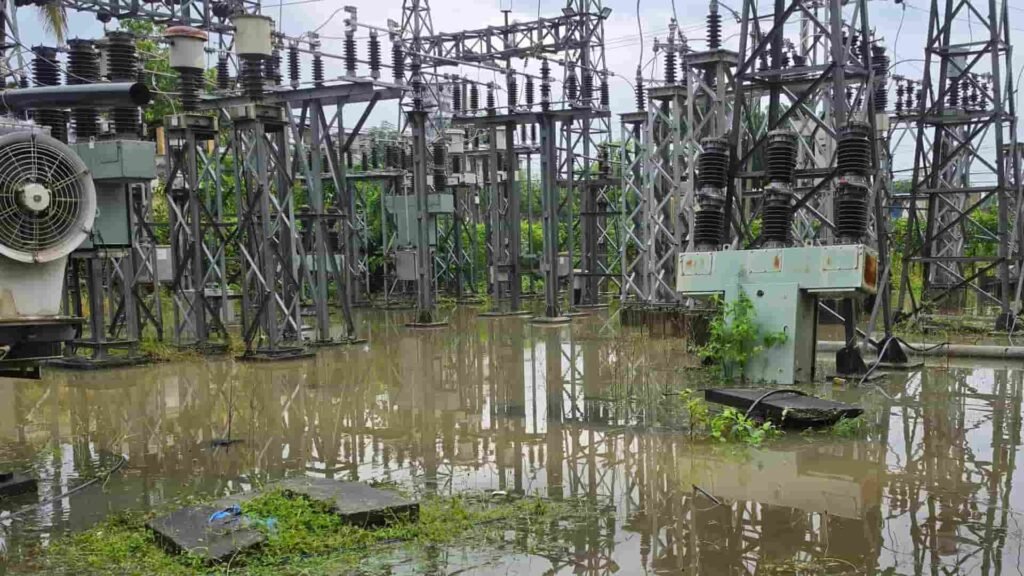
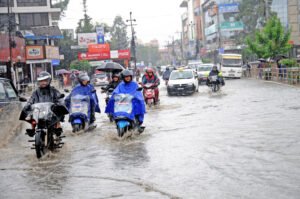
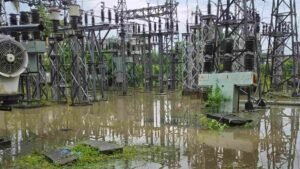
Floods and landslides resulting from continuous rainfall in Nepal have disrupted power transmission and distribution systems across various parts of the country. Power supply has been interrupted in several areas due to faults in transmission lines and equipment malfunctions at power generation stations and substations.
According to the Ministry of Energy, Water Resources and Irrigation, the power system has been significantly impacted in the Pokhara, Butwal, Hetauda, and Kathmandu regions. Disruptions affecting various lines, power generation, and load have impacted a total capacity of approximately 1,303 megawatts. However, this figure does not represent a simultaneous power outage; rather, it is the aggregate of disruptions related to lines, generation, and load occurring at different times and locations.
The Pokhara region has borne the brunt of the floods. A fault in the Kushma–New Butwal 220 kV transmission line affected approximately 200 megawatts of power. Similarly, issues with the Rahughat–Dana Line-1 and Line-2 affected around 155 megawatts. The floods have disrupted generation and power supply for several hydroelectric projects, including Kaligandaki, Upper Madi, Super Madi, Sikles–Namarjung, Seti River–Karuwaset, Upper Dordi, and Modi. Projects in the Pokhara region alone have seen an impact exceeding 400 megawatts.
In the Rahughat area, approximately 110 megawatts were affected due to a fault in the New Butwal–Kushma 220 kV line; this line was expected to be restored by 9:50 AM. In the Butwal region, a fault occurred on the New Bharatpur–New Butwal 220 kV transmission line after a tree fell on it. According to reports, the line was re-energized at 9:51 AM. Load shedding was implemented at the Kawasoti substation for approximately one hour due to the shutdown of the Chapar-Pathlaiya 132 kV line.
The power system in the Hetauda region was also affected by the floods. Approximately 32 MW of power generation linked to the Mandu 66 kV line was impacted. Power supply was disrupted at the Bharatpur substation—part of the Kawasoti-Bharatpur 132 kV line—due to the burnout of a CVT (Capacitor Voltage Transformer). Additionally, power supply was affected for about 20 MW at the Simara substation; approximately 80 MW for industries in Amlekhgunj, Parwanipur, and Birgunj; and around 25 MW for the Kamne substation and associated industries.
Power supply was also briefly interrupted in the Patan and Teku areas of Kathmandu. Outages occurred at the Patan substation from 9:00 AM to 9:10 AM, with a simultaneous disruption at Teku. In the Patan area, the issue arose from the simultaneous overloading of the Pathlaiya line and the KL-1 Syuchatar 66 kV line. Following the disruption of the regular supply due to the floods, the MRS (Main Relay Station) emergency supply was utilized.
Key factors contributing to the power system issues included flood-related damage to transmission lines and power generation centers, line faults, malfunctions in substation equipment, and the resulting overloads. Disruptions, particularly along the Pokhara-Butwal 220 kV transmission corridor and the 132 kV transmission network around Pathlaiya, have had a significant impact on the power supply in western and central Nepal.