Korala border customs revenue surges as cargo diverts from closed crossings
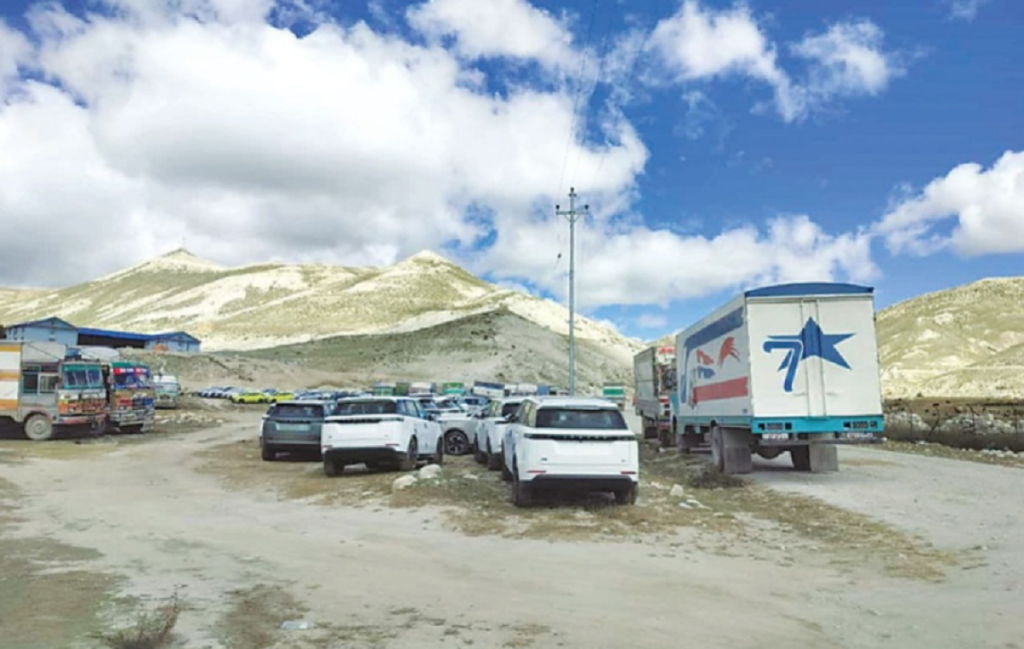
The Korala border crossing in Mustang has seen a sharp rise in cargo traffic after floods on August 26 closed Nepal’s two main trading points with China, Rasuwagadhi and Tatopani, diverting freight to the northern Mustang route.
The customs office at Nechung in Lomanthang Rural Municipality is located 13 kilometres from the Korala border point. Before August 26, the office cleared five to six cargo containers a day under normal conditions and eight to 10 during festivals.
By August 26 of the current fiscal year, the customs office had cleared 163 electric vehicles and 133 cargo containers through Korala. Since then, the number of containers being cleared has risen to around 50 a day.
The containers are carrying ready-made and fashion goods, beauty products, apples, garlic and industrial raw materials for the festival and winter seasons.
“Containers that used to come through Rasuwagadhi and Tatopani have been diverted here,” said Bidur Chudal, chief customs officer at the Mustang Customs Office. “The pressure has also increased because containers are being diverted from Shigatse and Lhasa.”
Despite major customs infrastructure on the Chinese side, Nepal is still operating the crossing with temporary facilities. The Customs Department has sent six additional employees to the office, which previously had 12 staff members, easing some of the shortage.
However, electricity and internet connectivity have become major problems as the office struggles to handle the increased workload.
Power supplied through the national transmission line is frequently interrupted, while Nepal Telecom’s fibre-optic internet connection from Mustang is also frequently disrupted and slow.
“From the time traders submit details of their goods to the work we do, everything is handled through a computer system,” Chudal said. “Frequent power cuts and slow internet have made it difficult to manage the increased workload. Traders are also facing problems.”
He said the office had asked Nepal Telecom to increase the capacity of the internet connection.
A building for plant quarantine was constructed after the Korala crossing began operating on September 16 last year. Since agricultural and forest products were not being imported or exported through the crossing, the building had been used as a police office.
After the August 26 floods, the Plant Quarantine and Pesticide Management Centre deployed a three-member team to Mustang under senior crop protection officer Prakash Paudel. As the quarantine building is occupied by police, the team is currently working from a tent.
An Armed Police Force border outpost and a Nepal Police team are also stationed at Nechung.
The increase in cargo traffic has also sharply increased customs revenue.
The customs office collected Rs520 million up to August 26 of the current fiscal year. From August 27 to September 10, however, it collected Rs1.5 billion.
“Despite the lack of infrastructure and various other problems, we collected Rs1 billion in revenue in 15 days,” Chudal said.
He said the customs office had also operated during winter in previous years and would be able to continue regular operations as long as the area did not experience prolonged heavy snowfall.
Mustang Chief District Officer Ajita Sharma said authorities were coordinating efforts to address infrastructure problems, including offices, staff accommodation and quarantine facilities at Nechung.
“The existing infrastructure was sufficient when there was less pressure,” she said. “The pressure has now increased. We are working to resolve the electricity and internet problems as quickly as possible.”