Infrastructure Minister Sunil Lamsal on rebuilding after the Bhotekoshi floods

Nepal’s Minister for Infrastructure Development, Sunil Lamsal, is actively overseeing the government’s efforts to restore physical infrastructure damaged by the catastrophic Bhotekoshi floods of August 26, while also helping shape plans to relocate communities exposed to future disaster risks. The floods have killed at least 1,384 people and left over 4,000 missing, according to the latest government figures. They also displaced thousands of families and damaged roads, bridges, hydropower facilities and other critical infrastructure across several districts.
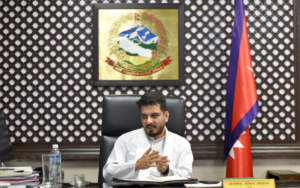
In an interview with Kantipur’s Gaurav Pokharel and Krishna Acharya, Lamsal discusses the government’s plans to provide temporary accommodation before the upcoming festive season, build safer settlements over the longer term and restore connectivity with China. He also dissects the response to the disaster, the role of foreign rescue teams, the damage to hydropower projects and roads, and criticism over the government’s handling of squatter settlements.
Although the meeting was expected to focus on the Bhotekoshi floods, it was a regular Cabinet meeting. Naturally, however, the disaster and its aftermath were discussed.
A total of 8,692 households, comprising 39,114 people, have been affected by the floods. We have set up 39 holding centres to accommodate the affected people. Our initial plan was not to keep people in these centres for more than a week. We felt that prolonged stays would create psychological and sanitation problems. But the stay has been extended because of circumstances on the ground.
The Cabinet has now taken decisions for both the short and long term to ensure that the survivors are not kept in holding centres any longer than necessary.
For long-term resettlement, the government has decided to develop integrated settlements. The Ministry of Land Management, Cooperatives, Federal Affairs and General Administration will identify suitable land. If privately owned land is selected, the government will purchase it. If forest or other public land is considered suitable, the government will take the necessary decisions to designate it for settlement development.
How long will that re-settlement process take place?
This process is expected to take two years. We cannot keep people in holding centres for two years. Our initial plan was to move them to temporary accommodation within 15 days, but connectivity problems prevented us from doing so.
What is your main priority for now?
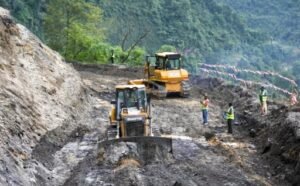
Our main priority now is restoring connectivity. Without it, the situation will become even more difficult, so we are working to restore access as quickly as possible.
At present, we can reach Betrawati by road. But to travel beyond Betrawati, we need to install a Bailey bridge. Another Bailey bridge is required on the road from Betrawati towards Syaphrubesi. The bridge has already arrived, but initially we could not reach the site where it was supposed to be installed.
What bottlenecks delayed the installation of the bridge?
A stretch of marshland, in places as deep as 20 metres, stood between the access point and the construction site. It was impossible to tell whether the ground was firm enough to walk on or whether someone would sink into the mud. Several technicians got stuck, and two machines sank. What we encountered was far more difficult than we had expected. It took three days just to recover the machinery.
We have now reached the bridge site and are working to restore the connection to Syaphrubesi as quickly as possible.
We have also asked the Chinese government to help restore the road from Rasuwa to Syaphrubesi. They have said they will help, although no agreement has been signed yet. As I understand it, they are preparing to assist us.
What latest updates can you offer regarding the bridge installation?
We had one 10-metre Bailey bridge and three 75-metre Bailey bridges. One has been installed at Devighat, and another will connect Betrawati with Syaphrubesi. The remaining bridges are not particularly useful for the current requirements.
We need a Bailey bridge of up to 120 metres to cross the Trishuli River. China sent two 100-metre bridges, but they did not meet our requirements. In the meantime, we have had to transport supplies by helicopter. Food, cooking gas and other essential goods have become difficult to deliver.
That is why we are talking to various companies about constructing the required bridge on a fast-track basis. We are working to restore all major connectivity before the festive season, if possible. This would improve access for 600,000 to 700,000 people.
The Cabinet has given us the mandate to do whatever is necessary to restore connectivity.
What has the government decided to do about people currently living in holding centres?
We have agreed on two approaches.
At Thursday’s Cabinet meeting, we decided to provide Rs15,000 a month to families of up to four members. For families with more than four members, an additional Rs2,000 per person will be provided.
The money will be distributed through the local units. It is intended as accommodation assistance for people who choose not to remain in holding centres.
Those who want to receive the assistance have to fill out a form at their local government office. We sent the forms to the local units a week ago.
In addition, those who choose temporary accommodation will be provided with temporary homes before the festive season, if possible.
Depending on the size of the family, we could provide one-bedroom, two-bedroom or three-bedroom units. The size will be determined by the number of family members.
What kind of temporary housing are you preparing for the affected people?
They will be proper temporary homes, not the kind of shelters built after the 2015 earthquake. These will not be sheds or tents. They will have toilets and kitchens. We refer to them as capsule houses. They are designed to function much like permanent homes.
The houses will be prefabricated in factories and assembled on site, with each unit capable of being completed in a day. They will serve as temporary accommodation until new townships are developed.
We will identify suitable sites and build the units there. They are prefabricated houses that can be assembled in a day.
Where will these temporary homes be built? Will they be close to the areas affected by the floods?
We have already identified 22 or 23 possible sites, mostly near the communities where the affected people lived. The local governments will recommend suitable locations. If no suitable land is available within an affected municipality, we will look at nearby areas.
Where will the components come from?
Primarily from China. Large quantities of these houses are manufactured there, and importing them from China is also more cost-effective.
We are exploring both options: receiving the houses as assistance from China or purchasing them. If China provides houses that meet our requirements, that would be fine. Otherwise, we will buy them.
When will these temporary homes be ready?
We aim to have them ready within 15 days of receiving verified details on the affected families and their accommodation needs.
We first need to establish how many people want temporary homes and how many prefer to receive rental assistance and live elsewhere.
Has the government started implementing the programme, or is it still in the planning stage?
We are currently identifying locations. We are considering various options.
The government is also preparing to identify other areas across the country that could be at risk from glacial lake outburst floods. We need to determine which routes and markets could be exposed to such risks and, where necessary, relocate them.
That assessment has already begun.
For long-term planning, including identifying safer locations and relocating settlements, we have formed a task force. We expect it to submit a detailed report, probably within a month.
We will then decide how to move the process forward. We have also formed task forces to deal with other aspects of the response. There is one looking into bridges, another for roads, and separate teams for temporary shelters and the management of holding centres. We also have task forces focused on drinking water, restoring connectivity and health. All of them have already started work.