What you should know about the article – and the platform – arguing Washington “groomed” Nepal’s new rulers
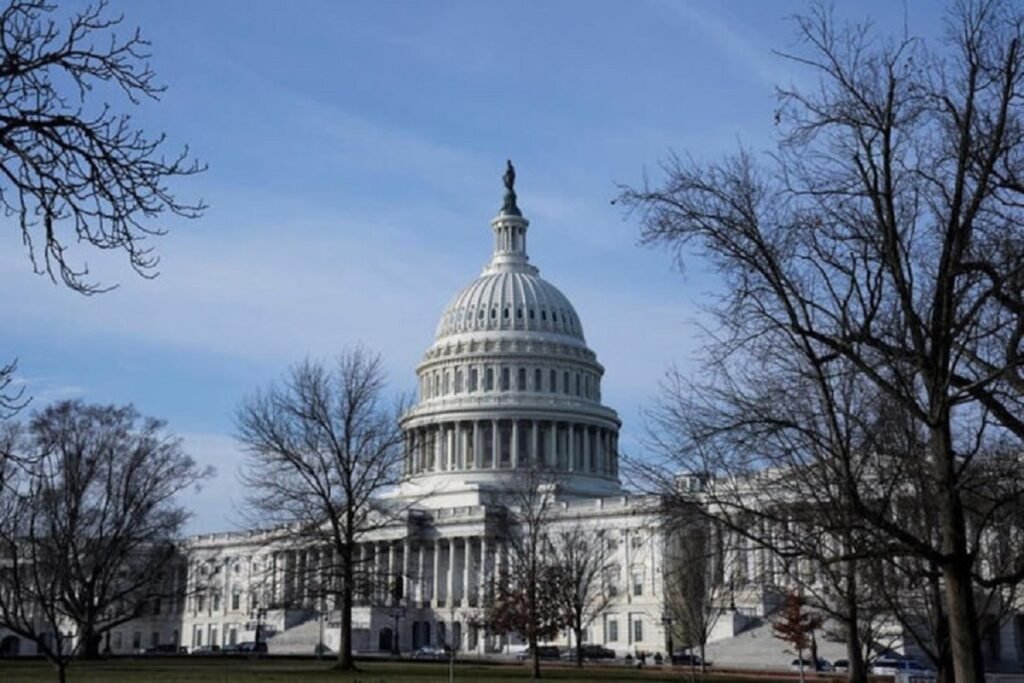
An article published on a U.S.-based website nearly two weeks ago has been shared widely, both on social media and over emails and WhatsApp groups. The article, published by The Grayzone, says that leaked documents show that Prime Minister Balendra Shah, Home Minister Sudan Gurung, ruling Rastriya Swatantra Party chair Rabi Lamichhane, and RSP parliamentarian Sagar Dhakal were “groomed for power” by a “U.S. regime change outfit.”
Questions about foreign influence in Nepali politics are not new. And this is not the first time Nepalis have openly argued about America’s intentions. Many social media users who are critical of the new administration have shared it as a settled fact. How most Nepalis who are engaging with the article and are sharing it depends on which side of the political spectrum you come from.
Against this backdrop, it is worth breaking down the article so readers can understand a few things: what the article actually claims; what is new information here and what is not; which people are intentionally left out to fit the narrative; and, most importantly, whether the document undergirding the article supports what the headline claims.
Grayzone says Shah and his colleagues came to power “thanks in part to a covert program sponsored by the US government.” It describes its reporting as a “new batch” of leaked documents and ties the story to growing public anger over the government’s handling of the response to Bhotekoshi and Trishuli floods on August 26.
The central document that underpins the whole argument is a 2019 annual plan for Niti Sambad — Policy Dialogue — a program in Nepal implemented by the Consortium for Elections and Political Process Strengthening (CEPPS). But the program wasn’t a secret. The dialogue was funded by the US Agency for International Development (USAID) and ran from 2017 to 2022, with a spending ceiling of $20 million. CEPPS is made up of three US organisations: the International Foundation for Electoral Systems, the National Democratic Institute (NDI) and the International Republican Institute (IRI).
USAID carried the program details on its website while it was running. The fact sheet it published at the time, a copy of which can be found on its archived website, said the program’s goals included making Parliament more transparent and inclusive, supporting the Election Commission, and helping political parties work more effectively. NDI advertised roles for Niti Sambad jobs on MeroJob, a leading job search platform. A mid-term evaluation of the programme, commissioned by USAID’s Nepal headquarters, was catalogued in USAID’s archive, which went offline last year.
The Grayzone calls CEPPS an offshoot of the National Endowment for Democracy. NDI and IRI do receive NED funding, but the accounting page Grayzone reproduces lists USAID’s Nepal mission as the operating unit. The annual work plan itself was an internal document, but it is not new. The Sunday Guardian, an India-based publication, reported its contents days before the Nepal elections, including the same list of names that are circulating at the moment.
The story dedicates a section on youth, arguing that young people are shut out of leadership roles in Nepali parties and that CEPPS partners would engage youth leaders across parties. It names Gagan Thapa and Bishwa Prakash Sharma from the Nepali Congress as rising young reformists, and suggests reaching out to younger leaders in left parties. It then lists five “catalytic civic leaders” CEPPS would support: Ujwal Thapa, Sudan Gurung, Balendra Shah, Sagar Dhakal and Rabi Lamichhane.
The article describes the list as four men who now lead RSP. Ujwal Thapa, the founder of Bibeksheel Nepali, whom many credit as the man who gave rise to alternative politics in Nepal, does not appear in the article. Neither do the two Nepali Congress leaders. Other sections of the plan name Upendra Yadav, Mahanta Thakur, CK Raut and Ang Kaji Sherpa as minority representatives to consult, and Ranju Darshana and Radha Paudel as women’s rights activists to support. The Grayzone article just mentions Darshana, who won a seat for RSP in March. It leaves out the others.
The article also says the US provided $20 million. The accounting document Grayzone reproduces lists $20 million as the total estimated amount and about $1.54 million as the amount committed when the page was prepared. The Sunday Guardian, in its March article, reported a budget of $4.3 million for the 2019-2020 plan.
Despite the work plan cited by both Grayzone and Sunday Guardian, it is unclear whether Shah, Lamichhane, Gurung or Dhakal took part in any Niti Sambad activity — and if they did, what the program actually involved.
The authors of the article themselves are not without controversy, and neither is the website. Kit Klarenberg is a British writer, and Wyatt Reed is an editor at The Grayzone, a site founded in 2015 by American journalist Max Blumenthal.
In June 2024, The Washington Post reported that hacked files from Press TV, Iran’s government-funded broadcaster, showed payments of thousands of dollars to Reed, Grayzone’s editor, for contributions in 2020 and 2021. At the time, he was also a correspondent for Russia’s state-owned Sputnik, a job he held from 2019 to June 2023. Klarenberg worked for Sputnik until 2019. In 2023, UK counter-terrorism police detained and questioned him at an airport about his journalism, a detention some supporters called an attack on press freedom.
Klarenberg has published leaked documents before. In 2022, Grayzone was the first outlet to publish stories based on hacked emails sent by a former director of the British intelligence service MI6, about a group of hardline Brexit campaigners. Google’s security team linked the leak to Cold River, a Russian hacking group, which the UK government says is run by Russian intelligence officers. Klarenberg said the files were sent to him anonymously over cloud sites and that he did not know their source.
In April 2022, weeks into Russia’s full-scale invasion of Ukraine, Klarenberg wrote that evidence strongly suggested Ukraine’s Azov Battalion had staged the destruction of a theatre in Mariupol, where hundreds of civilians were sheltering. In the same article, he also said reports of a massacre in Bucha contained suspicious details. Two months later, Amnesty International said, based on dozens of survivor and witness accounts, that the theatre was almost certainly bombed by Russian aircraft. The incident has been described as one of Russia’s most notorious war crimes. Klarenberg never posted a correction.
In other instances, Grayzone writers have argued that the 2018 chemical attack in Douma, Syria may have been staged, after the Organisation for the Prohibition of Chemical Weapons (OPCW) investigation team concluded that a Syrian air force helicopter dropped two chlorine cylinders on apartment buildings, killing 43 people. In 2019, the site published an article disputing claims that China had detained millions of Uyghurs in Xinjiang. China’s State Council Information Office republished it on the same day.
All of this doesn’t mean Washington hasn’t funded this kind of work in Nepal. It has been for more than a decade. In 2010, USAID’s Nepal mission awarded CEPPS a cooperative agreement that grew to about $30.8 million before it ended in 2017, according to federal spending records. The program at the center of this article, Niti Sambad, replaced that previous project. The 2019 work plan says its youth programmes were “in line with the objectives of the Indo-Pacific Strategy,” the U.S. policy for the region. What that actually means in practice is something neither the Americans have explained nor Nepalis have probed further about.