Rice transplanting improves on last year’s pace
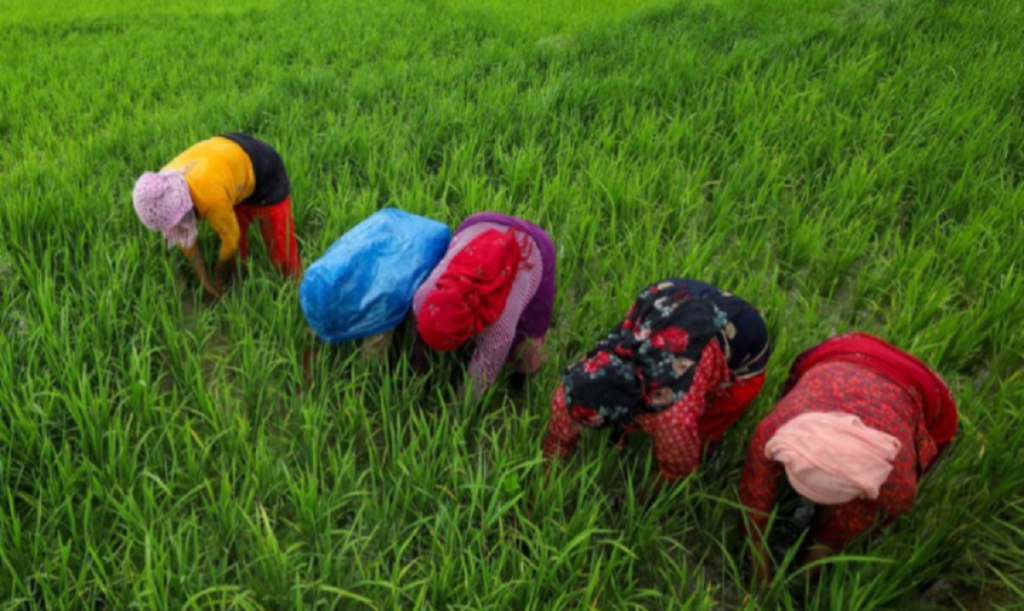
Rice transplanting is nearing completion across Nepal, with farmers having covered 97.48 percent of the country’s paddy fields by August 14, compared with 94 percent at the same stage last year. Agriculture authorities expect production to rise if the crop escapes major weather-related disruptions.
Farmers had transplanted rice on 1.336 million hectares out of a total paddy-growing area of 1.370 million hectares, according to the Department of Agriculture under the Ministry of Agriculture, Forests and Environment.
At the same point last year, transplanting had reached 94 percent, covering 1.303 million hectares.
The transplanted area is therefore about 30,500 hectares larger than at the same stage last year.
The faster pace this year has raised hopes of a stronger harvest after rice production fell by 4.2 percent last year. But officials caution that the final output will depend on weather, crop diseases, pests and other risks during the growing and harvesting periods.
Sudurpaschim has completed transplanting across all its paddy fields. Karnali has recorded 97.79 percent completion, followed by Bagmati at 97.82 percent, Koshi at 97 percent, Gandaki at 96.68 percent, Madhesh at 96.6 percent and Lumbini at 97.87 percent.
The biggest improvement has been recorded in Madhesh, where only 86.35 percent of the fields had been transplanted at the same time last year. This year’s figure of 96.6 percent represents a 10.25 percentage-point increase.
Gandaki has also seen an improvement, with rice transplanting rising from 94.83 percent last year to 96.66 percent this year. In Koshi, the rate increased from 96.67 percent to 97 percent, while in Bagmati it rose from 97.27 percent to 97.52 percent.
Lumbini, however, has recorded a slight decline. Rice transplanting stood at 98.37 percent last year, compared with 97.87 percent this year.
Sudurpaschim completed rice transplanting in full last year and has again reached 100 percent this year. Karnali, meanwhile, has seen a decline from 99.34 percent last year to 97.79 percent this year.
“Transplanting is virtually complete this year. Once the remaining figures come in, we expect the rate could reach around 98 percent,” said Rajendra Koirala, deputy director general of the Department of Agriculture. “The progress this year is encouraging.”
Koirala attributed last year’s slower pace partly to drought, which particularly affected Madhesh. This year, rainfall during the past week helped farmers in the province complete transplanting more quickly, he said.
The timely completion of transplanting could also boost production, according to Koirala.
“If there are no disasters in between, the current transplanting situation suggests that rice production will increase,” he said.
But while government agencies are optimistic about the harvest, farmers continue to face shortages of fertiliser and other inputs, as well as the risk of weather-related losses.
Nepal’s rice production fell by 4.2 percent in fiscal year 2025-26 to 5.705 million tonnes, according to government data. Production stood at 5.956 million tonnes in fiscal 2024-25, after reaching 5.724 million tonnes in 2023-24.
Shashiram Acharya, treasurer of the National Farmers’ Group, said fertiliser shortages remained a major concern even though rice transplanting had largely been completed.
“Transplanting is over, but there is still not enough fertiliser. This is precisely the period when farmers need it most,” Acharya said. “Without enough fertiliser, production cannot reach the expected level.”
He said farmers were still struggling to obtain fertiliser despite government warehouses having stocks.
According to the 2021 national sample census of agriculture, 2.765 million farmers grow rice in Nepal, up from 2.681 million recorded in the 2011 census.
Rice is Nepal’s most widely grown crop and accounts for the largest share of agricultural output. Agriculture accounted for 24.16 percent of Nepal’s gross domestic product in fiscal 2025-26.
Keshav Devkota, head of the Centre for Crop Development and Agro Bio-diversity Conservation, said the favourable transplanting situation pointed to the possibility of higher production this year, although it was too early to make a firm forecast.
“Production cannot be measured at this stage. Crops can still be hit by disease, floods or damage during harvesting,” Devkota said. “But based on the transplanting progress, production appears likely to increase.”
Fertiliser availability for rice farming has also been relatively better this year, while timely transplanting could further support yields, he said.
The final production outlook, however, will depend on crop growth, weather conditions and the prevalence of pests and diseases, Devkota said.