Resettling disaster survivors takes more than finding them new homes
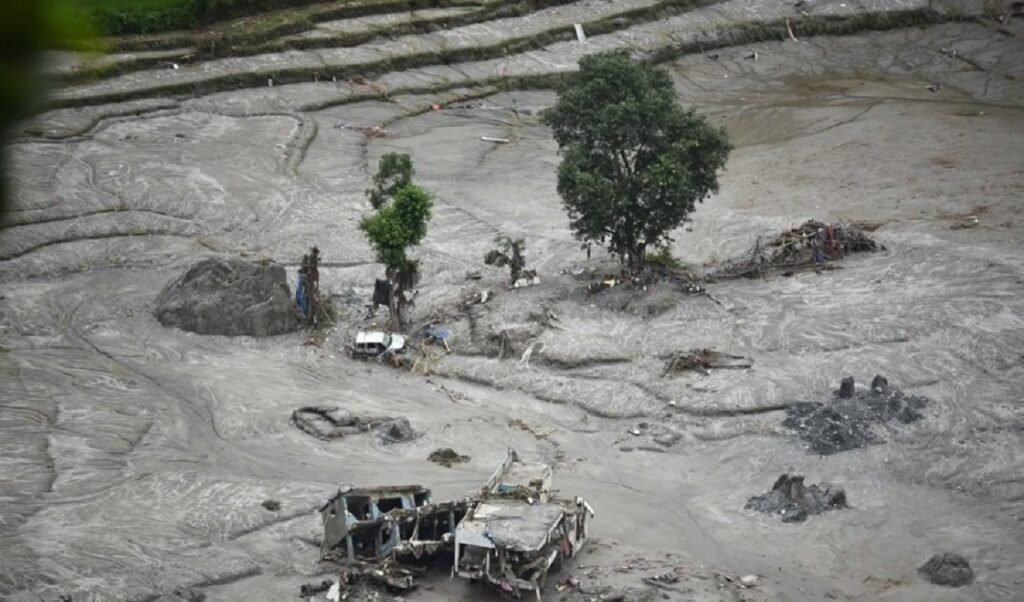
Chegu Tamang of Khalte in Rasuwa’s Uttargaya Rural Municipality lost 14 relatives in the August 26 floods. The 2015 earthquake had already forced him from his home. Now, the floods have left him with nowhere to return. He initially sheltered at a holding centre at Shivalaya Basic School in Uttargaya but is now staying at Himalaya Academy in Bidur, Nuwakot.
Khalte had 257 households, and preliminary estimates put the death toll at around 400. The village had already been badly damaged by the 2015 earthquake, which displaced residents and left the settlement vulnerable. Geologists had warned that it was unsafe for habitation.
“We were displaced by the earthquake and moved to Bogatitar. Some families put up temporary shelters in Satbise and Naubise,” Tamang said. “We spent three years in Bogatitar, but the authorities never moved us somewhere safe. Eventually, we built our own shelters near the river in Khalte because we had nowhere else to go. The government failed to find us safer ground in time, and now the whole village has paid the price.”
Khalte is far from the only example. Time and again, disaster survivors have been left without safe places to settle, forcing many to return to areas still exposed to risk. The failures of past resettlement efforts have done little to change how the government or affected communities prepare for the next disaster.
The government says it has begun work on relocating settlements rendered uninhabitable by the Bhotekoshi flood. One option is to move families to other districts, while another is to identify vacant land within their own districts. But the troubled history of resettlement after the 1993 floods and the 2015 earthquake suggests that rebuilding lives will be far more difficult than finding land and constructing houses.
The floods and landslides of July 1993 killed 1,336 people across Makawanpur, Chitwan, Sarlahi, Rautahat, Sindhuli, Kavre and Dhading, while causing widespread physical damage. More than 408,000 people were affected. The Bagmati river corridor was among the worst-hit areas, according to the Nepal Disaster Report 2011.
With support from Taiwan, some families displaced by the floods were resettled in newly built homes in Hariwan, Sarlahi. But many eventually returned to their original homes once the floodwaters receded, said Bhojraj Pokharel, the then home secretary. “A model settlement was built along the Bagmati for flood-displaced landless people and squatters, but the project failed to take off,” Pokharel said. “People returned to their villages because that was where their farms and social networks were.”
The 2015 earthquake offers another example of the challenges of resettlement, even when people are provided with new houses and land. After the earthquake, the entire village of Laprak in Gorkha was moved to Gupsi Pakha. The Non-Resident Nepali Association built 602 houses, intending to create a model settlement. But many of the houses now lie empty, while residents continue to live in their earthquake-damaged homes in Laprak. According to the Ministry of Urban Development, another 46 settlements were relocated after the earthquake. Even there, many people were reluctant to move.
Experts involved in post-disaster reconstruction say resettlement plans must take into account people’s livelihoods, social and economic ties, and exposure to future risks. Pokharel, who was involved in the response to the 1993 floods, says Bhotekoshi survivors should have a say in where they are relocated. “Moving displaced families far away from their original settlements can cut them off from schools, healthcare, markets, jobs and farmland. Those needs must be considered,” he said. “Providing financial assistance and moving people to a place that happens to be convenient for the government does not absolve it of its responsibility.”
Purna Bahadur Ghale of Khalte, who lost seven relatives in the flood, is also hoping the government will do more than make promises. He is currently staying at the holding centre at Shivalaya Basic School. “I barely survived the 2015 earthquake,” he said. “I went to Singha Durbar again and again, pleading with the government to move us somewhere safer. Officials kept promising to do so, but nothing ever happened. Now I have lost my family.” He wants the government to provide survivors with safe housing and a way to earn a living. “Survivors must be relocated to a safe place where they can also sustain their livelihoods,” he said.
The August 26 flood swept away nearly 15 large and small settlements across Rasuwa, Nuwakot and Dhading. A preliminary report by the National Disaster Risk Reduction and Management Authority says 1.6 million people were directly affected.
The government has begun identifying settlements that are no longer safe for habitation, said Dharam Raj Uprety, chief executive of the authority. “People cannot return to settlements swept away by the floods,” he said. “The government has formed teams and started work to relocate them to safer places. We will announce a resettlement plan soon.”
But Madhav Prasad Aryal, chair of Uttargaya Rural Municipality, fears that the process could drag on just as it did after the earthquake. In his assessment, the failure to resettle earthquake-displaced families contributed to the even greater loss of life in the latest disaster
Gunakar Bhatta, vice-chair of the National Planning Commission, said the government had begun planning for recovery following a post-disaster needs assessment. “Alongside rebuilding damaged infrastructure, we will prepare a comprehensive master plan for settlement development and broader reconstruction,” he said. Gopal Sigdel, secretary at the Ministry of Physical Infrastructure Development, which has been tasked with infrastructure work, said the government would draw up a long-term plan for resettlement once road connections to affected areas were restored.