Nepal’s Foreign Minister Assures China of Unchanged Diplomatic Ties Under New Administration
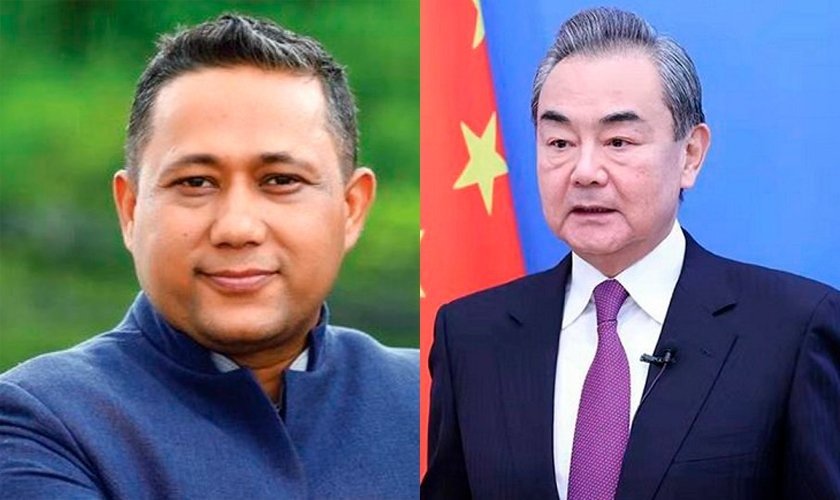
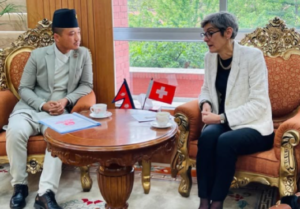
In a high-stakes diplomatic meeting aimed at providing strategic clarity, Nepal’s Foreign Minister Shisir Khanal has assured the Chinese government that Kathmandu’s foreign policy stance toward Beijing will remain steadfast and unchanged. On Tuesday, Nepal’s Foreign Minister Shisir Khanal delivered the assurance to Chinese Ambassador Zhang Maoming during his visit to the Ministry of Foreign Affairs. The meeting comes at a critical juncture as the new administration, led by Prime Minister Balendra Shah and the Rastriya Swatantra Party (RSP), seeks to establish its international footprint following a landslide victory in last month’s parliamentary elections.
Ambassador Zhang’s visit served multiple purposes, including the delivery of congratulatory messages from top Chinese leadership, including Premier Li Qiang and Foreign Minister Wang Yi. However, the meeting quickly shifted toward substantive policy discussions. According to officials present, the Chinese envoy sought explicit assurances regarding the new government’s attitude toward China, its adherence to past bilateral agreements, and its overall foreign policy orientation. In response, Minister Khanal emphasized that Nepal’s principled position is enshrined in the nation’s constitution and its established foreign policy doctrine, which maintains a rigorous commitment to independence and non-alignment.
A central theme of the discussion was the “One-China” principle. Minister Khanal explicitly reiterated that the new government would continue to support this stance and firmly stated that Nepal would not allow its territory to be used for any activities directed against its neighbors, including China. This clarification was particularly significant given the recent rumors circulating on social media regarding the RSP’s potential shift in geopolitical alignment. To counter these perceptions, the minister noted that the government’s priorities remain domestic—focusing on good governance, effective service delivery, and economic stability—while expecting continued cooperation from Beijing to achieve these developmental goals.
The dialogue also touched upon the implementation of past accords, including the ambitious Belt and Road Initiative (BRI). Ambassador Zhang raised the issue of jointly developing projects under the BRI framework and extended a formal invitation for Minister Khanal to visit China. Both parties expressed a mutual desire to resume stalled bilateral mechanisms, including the Foreign Secretary-level Bilateral Consultative Mechanism (BCM), which is tentatively expected to convene in June or July. Discussions further explored strengthening trade, tourism, investment, and cross-border connectivity projects, such as the second phase of the Kathmandu Ring Road expansion.
The meeting also addressed underlying anxieties regarding Prime Minister Balendra Shah’s previous diplomatic stances. Observers pointed out that during his tenure as mayor of Kathmandu, Shah had expressed strong views on boundary issues and the Lipulekh map controversy. However, political analysts, including Rupak Sapkota, suggest that the presence of experienced hands in the Finance and Foreign Ministries provides a stabilizing influence. Sapkota noted that major powers are currently seeking policy predictability and stability in Kathmandu, particularly regarding the execution of infrastructure projects and the maintenance of an independent foreign policy.
In a show of reciprocal commitment, Ambassador Zhang assured the Foreign Minister of Beijing’s full support and cooperation for the new RSP-led government. He expressed appreciation for Nepal’s consistency in upholding longstanding diplomatic principles. As the new administration in Kathmandu begins its term, this meeting represents an important milestone in bridging the gap between domestic political shifts and international strategic expectations. By prioritizing continuity and mutual respect for core interests, both nations appear poised to maintain a smooth and functional working rapport in the coming years.