‘Antardrishti’ Exhibition Showcases Sangee Shrestha’s Journey of Memory and Spiritual Reflection
Artist explores inner vision, femininity and spirituality through geometry, bold colours and symbolism
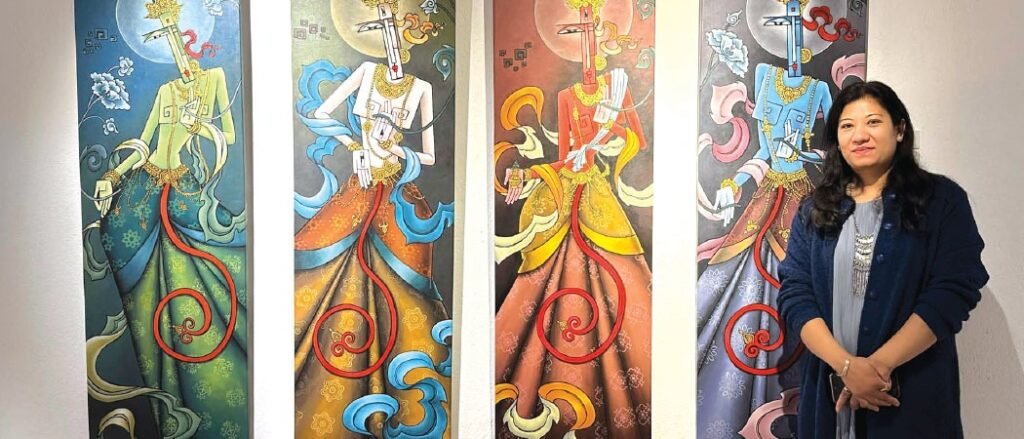
A new art exhibition titled Antardrishti by Nepali artist Sangee Shrestha is currently drawing attention at Kala Salon. The exhibition presents a deeply personal exploration of memory, spirituality and self-reflection through paintings and ceramics.
With over three decades of artistic practice, Shrestha believes that art begins where words end. Her works in Antardrishti, which means “inner vision,” do not portray a single moment but instead represent a fluid journey of self-discovery. The collection features 116 artworks, including canvases and ceramic pieces, each designed to evoke emotional and reflective responses from viewers.
Geometry plays a central role in many of Shrestha’s paintings. Rectangles, squares and polygonal shapes frame her subjects, symbolising how human emotions exist within the boundaries of modern life. Through these forms, the artist seeks to express the complexities of contemporary society and personal introspection.
Women frequently appear as the central figures in her works. Through them, Shrestha explores themes such as femininity, motherhood and divinity. Vibrant shades of red—often seen in the form of tika marks or lips—stand out across many of the paintings, symbolising both spiritual identity and emotional intensity.
One of the exhibition’s most striking pieces depicts a woman with seven eyes, wearing a crown that symbolises divine power. The artwork also features a lotus flower and bud, representing generational continuity and nurturing. According to the artist, the piece reflects her emotional journey following the loss of her mother.
Shrestha also incorporates elements from Hinduism and its mythology, not by directly copying traditional imagery but by absorbing and reinterpreting its symbolic meanings. In several works, the artist references the concept of the Trigun—Sattva, Rajas and Tamas—three fundamental qualities believed to influence human nature.
Beyond paintings, the exhibition includes ceramic sculptures that extend Shrestha’s exploration of human experiences into three-dimensional forms. She describes the kiln as a creative partner, transforming clay through heat and adding unexpected textures and tones to the final work.
The exhibition also features a series of collage pieces created from fragments of her earlier artworks. Through these pieces, Shrestha reflects on her past and connects it with present concerns, including themes such as climate change and environmental awareness.
Curator Sophia L Pande describes Antardrishti as the result of nearly two years of intense reflection and artistic effort. According to her, the exhibition highlights Shrestha’s ability to transform personal memories and emotions into powerful visual expressions.
Rather than offering clear explanations, the artworks invite viewers to interpret them individually. Through colours, symbols and subtle narratives, Shrestha encourages audiences to pause, reflect and explore their own inner thoughts.
Ultimately, Antardrishti stands as a quiet yet powerful reminder that art can serve as a mirror—connecting the artist and the observer in a silent dialogue of emotion, memory and spiritual reflection.