Early Morning Quake Jolts Nepal’s Koshi Province; Shocks Felt Across Four Neighboring Nations
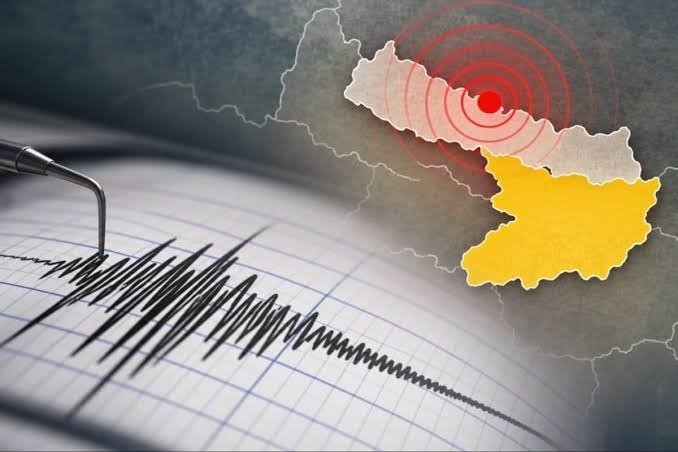
An earthquake registering a magnitude of 5.3 struck near Lelep in eastern Nepal’s Koshi Province on Tuesday morning, sending noticeable tremors rippling across several parts of India as well as neighboring Bhutan, Bangladesh, and China, though initial assessments indicated no immediate casualties, injuries, or significant property damage. According to preliminary data released by the United States Geological Survey, the seismic event occurred at approximately 7:02 a.m. Indian Standard Time, catching residents across the eastern Himalayan belt during their early morning routines. India’s National Centre for Seismology corroborated the timing and pinpointed the epicenter at latitude 27.855 degrees North and longitude 87.909 degrees East, situated at a relatively shallow depth of 20 kilometers beneath the Earth’s surface. Meanwhile, Nepal’s own National Earthquake Monitoring and Research Centre recorded a slightly higher reading, measuring the tremor at magnitude 5.6 with its epicenter localized near Olangchung Gola in the remote Taplejung district, positioned close to the mountainous Nepal-Tibet border, according to local media reports. Such minor variations in initial magnitude and exact coordinate estimates are common among international and regional seismological agencies due to differences in monitoring station proximity and local crustal modeling. Because shallow-focus earthquakes transmit seismic waves efficiently across upper geological layers, the resulting ground shaking was felt across wide swaths of eastern Nepal, northeastern and northern India, Bhutan, Bangladesh, and southern Tibet in China. Despite the widespread perception of the early morning jolts, disaster management authorities and local administrations across the affected territories reported no immediate signs of structural collapse, infrastructure disruption, or harm to residents. Emergency response teams across the border districts remain on standard alert, conducting routine ground checks in remote mountain villages to ensure that no delayed landslides or minor structural cracks have occurred along steep Himalayan slopes. The eastern Himalayas sit along one of the world’s most active tectonic boundaries, where the continuous northward collision of the Indian tectonic plate beneath the Eurasian plate frequently triggers moderate to strong seismic activity. Seismologists continue to monitor regional fault lines for any potential minor aftershocks, though standard geological patterns suggest that moderate earthquakes at this depth typically dissipate without triggering major secondary hazards. Local officials have urged residents to remain calm and rely strictly on verified updates from national geological agencies while field verifications continue. Ultimately, the Tuesday morning tremor served as a timely reminder of the Himalayan region’s underlying seismic sensitivity while reassuring communities across Nepal, India, Bhutan, Bangladesh, and China that daily life, transport networks, and essential public services remain completely uninterrupted as authorities await final ground reports.