The agony of reclaiming lost territory
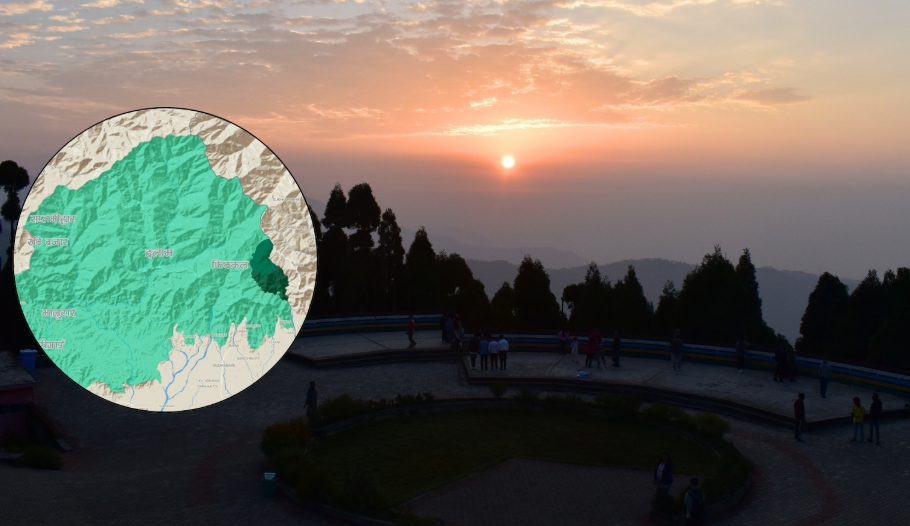
Agency: ‘We get to see the special, miraculous play of the autumn sun in the hide-and-seek of red and yellow colors on our high Himalayan peaks. Such a sight can be witnessed on all the snow peaks like Machhapuchhre, Annapurna, Dhaulagiri, Manaslu, and Makalu. However, the Antu experience in Ilam holds a special place in my memory. While viewing the ascending rising sun by gazing eastward from Antu Hill, one must not forget to look at the successive pours of orange, golden, and silver hues on the Kanchenjunga snow peak behind one’s back. If we miss it even for a moment, we are left with great regret.’
Dr. Tirtha Bahadur Shrestha
Such an incomparable place was absorbed into Sikkim following the 1816 Sugauli Treaty. Had Nepal’s officials not demonstrated shrewd diplomacy, this treasured land would not belong to Nepal today. To witness the breathtaking vista described by Dr. Shrestha, one would have been forced to travel across the border into what was then Mughlan.
The story of how this territory was regained is a remarkable tale:
After the Sugauli Treaty, the British started hastily drawing the map of the border with Nepal. In this process, while drawing Nepal’s border with Sikkim, they labeled the Siddhi Khola as the Mechi River and pushed Antu into the Sikkim side. In doing so, 45 square kilometers of land, or about 37 percent of the Bhaktapur district area, which is now called Shree Antu and Samalbung, went to the other side.
Around 1826/1827, the King of Sikkim assassinated his prime minister and maternal uncle. Following this, high-ranking officials, including the Kaji, fled to Ilam with 800 families of Lepcha and Limbu people and began attacking Sikkim from there.
During the Sugauli Treaty, the British had seized a lot of land from Nepal for themselves. The hills east of the Mechi were given to Sikkim. In that treaty, a condition was imposed on Nepal that any border dispute with Sikkim must be resolved according to the British decision. About one year after the Sugauli Treaty, they signed a treaty with Sikkim, imposing the same condition on Sikkim—that any border dispute with Nepal must be resolved according to the British decision. Based on this, Sikkim filed a complaint with the British, claiming that Nepal had encroached upon the border at Antu.
Following this, the British dispatched Captain William Lloyd in 1828 to resolve this border dispute. In the winter of that year, he and his colleague, J. W. Grant, traveled deep into Sikkim under this pretext (it was during this trip that they determined Darjeeling would be suitable for the British to establish a sanatorium). They concluded that Nepal had encroached on the border at Antu and submitted a report. Nepal wrote to the British Ambassador, Hodgson, about this matter. When Hodgson inquired with Major Latter, the British officer stationed in the east, Latter replied that Captain Hari Bhakta had exaggerated the difference in his report.
The Mechi River, the eastern border river, does not originate from the Himalayas in the same way the Mahakali, the western border river, does. The Mechi River ends roughly halfway along the north-south border in the east. At the spot where this river terminates, there are three streams: Kechi, Mechi, and Siddhi.
The British asserted that these three distinct streams—Kechi, Mechi, and Siddhi—were, in fact, the same river. When the captain questioned the local residents about this claim towards 1835, they firmly refuted it, stating, “Siddhi is Siddhi, Mechi is Mechi, and Kechi is Kechi. We previously confirmed that Siddhi is Siddhi and Mechi is Mechi. No one has the authority to call Siddhi the Mechi, or the Mechi the Siddhi. Even in Sikkim, the stream that flows eastward from below Antu Danda and converges near the main Nagari road is known as Kechi. The river to its west is called Mechi. Furthermore, the stream to the west of Antu (Vanatu, as it was known then) Danda is unequivocally designated as Siddhi.”
Hari Bhakta then measured the distance between the sources of the Siddhi and Mechi rivers and found it to be 225 cubits.
Major Latter was in Sikkim at that time. After he returned, Captain Hari Bhakta prepared to meet Major Latter with witnesses who knew that Kechi, Mechi, and Siddhi were separate. He promised Bhimsen Thapa, “If, during a friendly and firm discussion with Major Latter—one that does not become too heated—we face any difficulty, I shall proceed to establish the boundary as per your command and instruction. If the difficulties are too great, I shall write and respectfully submit the matter.”